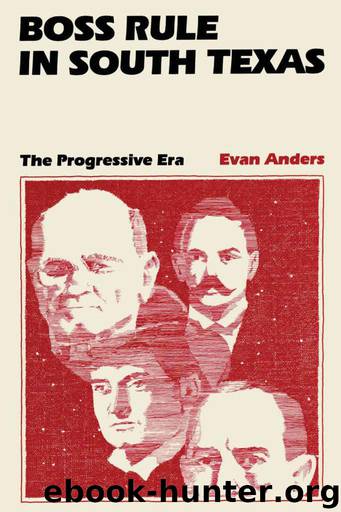
Boss Rule in South Texas: The Progressive Era by Evan Anders
Author:Evan Anders [Anders, Evan]
Language: eng
Format: epub
Publisher: University of Texas Press
Published: 2013-11-18T07:00:00+00:00
9. Archie Parr and Duval County
AS JAMES WELLS STRUGGLED to maintain his control over Cameron County politics at the end of the first decade of the twentieth century, the most enduring of all the South Texas machines took shape in Duval County. Located north of Starr County and west of Nueces County, the region remained undeveloped and sparsely populated until the 1870s as the result of recurrent Indian raids. Although the Texas Legislature authorized the creation of Duval County in 1858, the local residents failed to organize a county government for another eighteen years. With the stationing of U.S. troops at San Diego, which became the county seat in 1876, and with the extension of a railroad from Corpus Christi to San Diego in 1879, American- and European-born stock raisers invaded the county to take advantage of the rich grasslands. By the early 1880s, Duval County had emerged as one of the leading sheep-producing areas of the state. The sheep boom collapsed in the mid-1880s because of falling wool prices and an epidemic that ravaged the flocks, but not even this setback stymied the growth of the county. Cattlemen replaced the sheepherders, and commerce prospered with the completion of the railroad line to Laredo. The discovery of oil at the Piedras Pintas field in 1903 offered the promise of further development, but large-scale production did not begin until the 1920s.
Between 1870 and 1900, the population of Duval County rose from 1,083 to 8,483. Although the Anglo-Americans and Europeans established their economic dominance with the acquisition of vast stretches of land, possibly as many as three hundred Hispanic families retained their ranches and farms. In addition, the Mexican Americans, most of whom worked as laborers on the ranches and in the few towns of the county, still formed over 90 percent of the population by 1900. During the nineteenth century, the only concentration of non-Hispanics existed at San Diego, where Anglos and migrants from Britain, Ireland, France, Spain, and Germany operated most of the local businesses. Even with an influx of Anglo farmers into the western section of the county after 1900, the overwhelming Hispanic majority remained intact.
Conforming to the pervasive South Texas pattern, Duval ranchers and businessmen managed the voting of their Hispanic laborers. Nevertheless, instability characterized the politics of the county from the mid-1880s through the first few years of the new century. Political power brokers regularly switched party affiliations, and a sizable body of Hispanic stockmen, farmers, and artisans remained independent of employer control. Personal loyalties and even bribery might still determine how they cast their ballots, but they did not necessarily vote consistently for the same party. Racial antagonism also complicated local politics. Unlike their counterparts closer to the Rio Grande, many of the American and European settlers in Duval County shunned the Hispanic culture and refused to assume paternalistic responsibilities for their workers. The lynchings of those charged with rustling and Hispanic resentment over the loss of land heightened tensions. Missing an opportunity to alleviate Hispanic
Download
This site does not store any files on its server. We only index and link to content provided by other sites. Please contact the content providers to delete copyright contents if any and email us, we'll remove relevant links or contents immediately.
| Anthropology | Archaeology |
| Philosophy | Politics & Government |
| Social Sciences | Sociology |
| Women's Studies |
The Secret History by Donna Tartt(19293)
The Social Justice Warrior Handbook by Lisa De Pasquale(12224)
Thirteen Reasons Why by Jay Asher(8995)
This Is How You Lose Her by Junot Diaz(6955)
Weapons of Math Destruction by Cathy O'Neil(6362)
Zero to One by Peter Thiel(5864)
Beartown by Fredrik Backman(5839)
The Myth of the Strong Leader by Archie Brown(5552)
The Fire Next Time by James Baldwin(5503)
How Democracies Die by Steven Levitsky & Daniel Ziblatt(5271)
Promise Me, Dad by Joe Biden(5189)
Stone's Rules by Roger Stone(5130)
A Higher Loyalty: Truth, Lies, and Leadership by James Comey(5017)
100 Deadly Skills by Clint Emerson(4972)
Rise and Kill First by Ronen Bergman(4836)
Secrecy World by Jake Bernstein(4796)
The David Icke Guide to the Global Conspiracy (and how to end it) by David Icke(4771)
The Farm by Tom Rob Smith(4549)
The Doomsday Machine by Daniel Ellsberg(4540)
